
How price, market cap, and circulating supply determine a $1 target
Basic formula and why supply scale matters
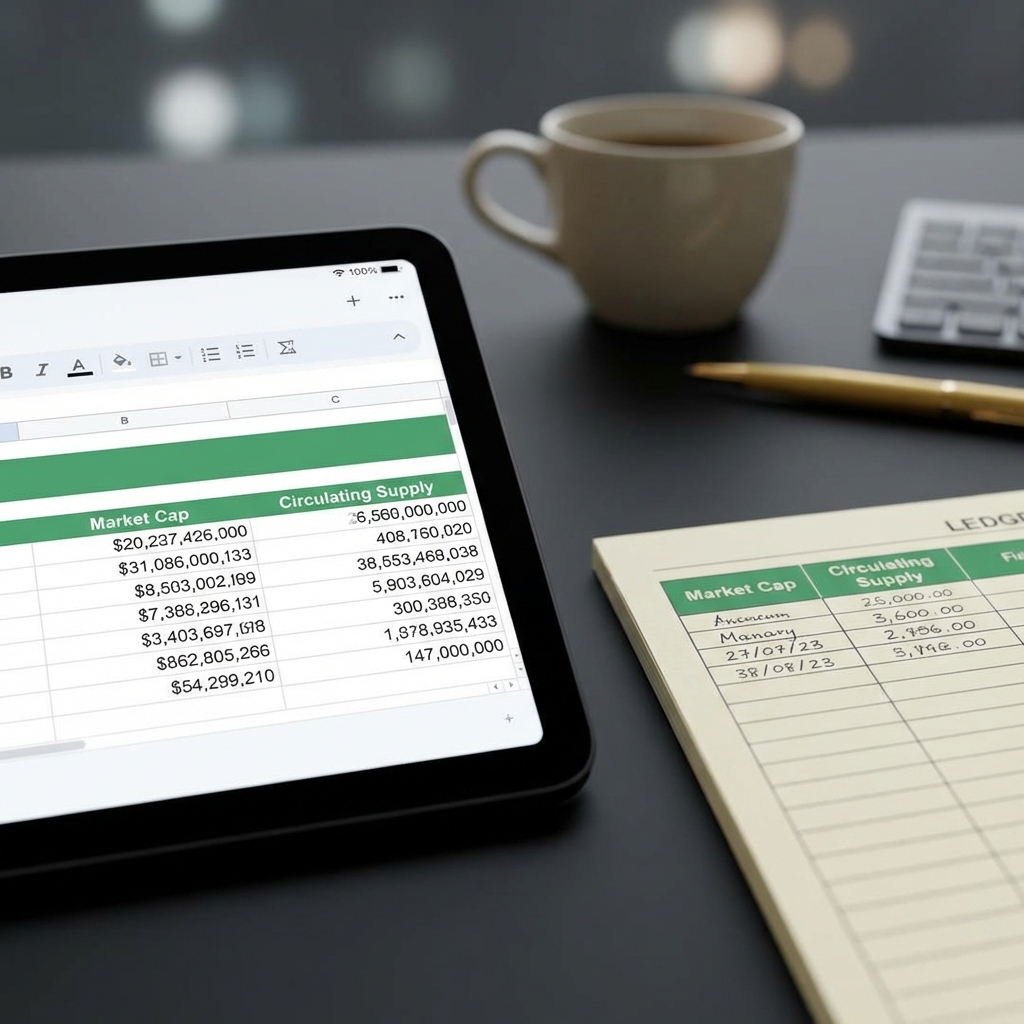
The core math is simple: price equals market capitalization divided by circulating supply. That relationship means the number of tokens in circulation is the primary constraint on whether a $1 price is feasible, because a very large supply requires a very large market cap to reach that price CoinMarketCap Research.
Put another way, for any fixed market cap a token with fewer circulating units will have a higher per token price. That makes supply scale a practical first filter when you are assessing a claim that a token can reach $1. Start by checking the circulating supply figure reported by primary sources.
Circulating supply is the amount of a token currently available to trade. Total supply includes tokens that are locked, held in treasury, or scheduled to unlock later. Mistaking total supply for circulating supply leads to overstated upside because future unlocks can dilute the circulating number and reduce the per token price Messari Research.
Token features such as scheduled vesting, token burns, or inflation rates change the effective supply over time. For a 2025 price view you should model expected circulating supply at your target date rather than using only the current number, since future unlocks can make a $1 target much harder to achieve.
Quick reading list of useful onchain and market numbers
When you run the formula yourself, gather these inputs: reported circulating supply, total supply and known unlock dates, recent average daily traded volume on major exchanges, and a conservative market-cap benchmark for your scenario. Use primary project documents and explorer data to verify these figures Messari Research.
run price = market cap / circulating supply scenarios
Use conservative market cap assumptions
To see implications without guessing, translate a proposed $1 price into the required market cap by multiplying the circulating supply by one dollar. That result alone does not say the market cap is realistic, but it gives a clear target to compare with plausible benchmarks and industry comparators CoinMarketCap Research.
Because the formula is linear, small changes in reported circulating supply or in planned unlock schedules can shift the required market cap substantially. Always note the date of the supply numbers you use and whether vested tokens will be released before your target date.
A simple framework to model whether a token could reach $1 by 2025
Step 1: Gather supply, vesting, and market-cap benchmarks
Start by collecting the tokenomics from the official project documents: current circulating supply, upcoming vesting or unlock dates, burn plans, and any stated inflation rate. These elements change the supply you should use in a 2025 scenario and can alter the plausibility of a $1 target Glassnode Insights.
Also record recent liquidity metrics: average daily volume on exchanges where the token is listed and typical order-book depth near the mid price. Those figures will feed into slippage and volume estimates later in the framework.
Step 2: Model realistic market-cap scenarios and time horizons
Convert a $1 target into a required market cap by multiplying the assumed circulating supply at your target date by one dollar. Then choose conservative, moderate, and optimistic market-cap benchmarks to test plausibility. Compare the resulting caps to market caps of tokens with similar supply and function to see if the numbers are within historical ranges Nansen Research.
Step 3: Test liquidity and slippage assumptions
Estimate how much buying volume would be needed to move price toward the required market cap given current order-book depth. Thin order books can make even moderate market-cap moves impractical because of slippage. Use historical trade depth or public research on liquidity to guide assumptions CoinDesk Research.

When you build the scenario in a spreadsheet, label each assumption clearly: supply at date, burned or locked tokens, a baseline market-cap target, and a volume-to-price model. Write the dates where token unlocks occur and treat those as checkpoints rather than uncertainties.
Key decision criteria: what makes a $1 scenario more or less plausible
Supply scale and tokenomics
Tokens with moderate circulating supplies, in the tens to low hundreds of millions, generally have a more plausible path to $1 than those with multi billion supplies, all else equal. That conclusion comes from comparing the market-cap size required at different supply scales and observing historical cases where similar supplies reached dollar prices under reasonable market growth assumptions Nansen Research.
Vesting schedules, burns, and inflation can materially change the effective circulating supply and should be folded into any plausibility assessment before you commit capital Messari Research.
Exchange listings and liquidity
Having the token listed across multiple reputable exchanges and demonstrating consistent order-book depth reduces the friction to a higher traded price. Low liquidity or listings concentrated on small venues increases the volume required and raises slippage risk, which can make a $1 scenario impractical in real trading terms CoinDesk Research.
Also consider whether large holders control a substantial share of supply. High concentration can create sudden sell pressure that offsets buying interest, so concentration is a risk factor to weigh alongside liquidity numbers Chainalysis Blog.
Network adoption signals and concentration risk
Measures such as active addresses, development activity, and steady onchain usage support a case for adoption, but they are signals not guarantees. Use them to build confidence in demand assumptions while keeping contingency plans for downside scenarios Chainalysis Blog.
Remain cautious about single event narratives. A new listing or partnership can temporarily lift price, but sustainable moves toward a $1 valuation depend on persistent demand and manageable supply dynamics rather than one-off announcements Nansen Research.
Monitoring checklist and triggers to watch after you take a position
Supply unlock dates, vesting and treasury movements
Track known supply unlock dates and vesting schedules, and mark them on your calendar. These dates are common triggers for selling that can increase supply and push price down if demand does not keep up Glassnode Insights.
Also monitor treasury movements and any announced token burns. Both can affect effective circulating supply and should prompt a re-evaluation of the required market cap to reach $1.
Whether a token can reach $1 by 2025 depends mainly on its circulating supply, the required market capitalization implied by that supply, tokenomics like unlock schedules, and practical liquidity conditions. Use the provided framework to test scenarios and set monitoring triggers rather than expecting guaranteed outcomes.
Set rules in advance that specify how you will reduce exposure if certain triggers occur. For example, plan to trim position if a large scheduled unlock happens without a corresponding increase in liquidity or if exchange inflows spike sharply CoinDesk Research.
Exchange listings and liquidity changes
Watch for new listings on significant exchanges and for widening or narrowing in order-book depth. A new high-quality listing can improve liquidity and plausibly lower the buying volume needed to reach higher prices, but such listings do not guarantee sustained demand Nansen Research.
Onchain signals to watch weekly
On a weekly cadence check active addresses, exchange inflows and outflows, and any abnormal transfers from large wallets that might indicate distribution. These signals correlate with short term price pressure but do not deterministically predict long term milestones Chainalysis Blog.
Keep a short log of these weekly observations and compare them to your scenario assumptions. If you see sustained divergence from assumptions, follow the written exit plan you created when you sized the position.
Common mistakes and pitfalls investors make when eyeing a $1 price
Ignoring total versus circulating supply
Confusing total supply with circulating supply inflates upside estimates because it ignores tokens that will unlock and dilute the market. Check project documents for explicit vesting tables and include those unlocks in a 2025 supply estimate Messari Research.
Also be cautious about one-time burns that are announced but not verifiable onchain. Prefer verifiable onchain proofs of supply reduction when possible.
Assuming ideal liquidity
Assuming you can buy a large amount at the current mid price ignores slippage. Large orders on thin books push the price up as each level is consumed, so real-world buying costs can be much higher than a simple market-cap calculation suggests CoinDesk Research.
Estimate the volume you would need and test that against recent depth to see if the liquidity exists in practice. If it does not, treat the scenario as conditional on future liquidity improvements rather than a current fact.
Overweighting hype or single events
Event-driven reasoning can be misleading. Listings, partnerships, or influencer hype sometimes lead to sharp but short lived price moves. Those events do not replace careful modeling of supply, sustained demand, and liquidity Chainalysis Blog.
Maintain a conservative position size and have explicit exit rules tied to the triggers noted earlier to reduce the chance of being caught by a reversal after a hype-driven run.
Practical examples and historical scenarios that illustrate the framework
Case patterns: low supply tokens that reached $1 versus high supply failures
Research through 2024 and early 2025 shows that tokens with circulating supplies in the tens to low hundreds of millions had more plausible paths to $1 under reasonable market-cap growth assumptions, compared with tokens that started with multi billion circulating supplies where the required market cap was typically implausible for a sustainable move Nansen Research.
That pattern reinforces the value of using supply scale as an early screening filter. It does not guarantee outcomes, but it narrows the set of tokens worth detailed modeling.
How market cycles and listings changed outcomes
Market cycles and major exchange listings have altered outcomes historically, sometimes accelerating price moves when liquidity flowed broadly and sometimes leaving smaller tokens isolated. Use cycle context and listing prospects as conditional inputs rather than proof of future results CoinMarketCap Research.
Remember that macro liquidity and sentiment can change rapidly; your scenario should include an explicit time horizon and what would need to happen in that period for the $1 target to remain possible.
A worked example using anonymized numbers to show the math
Worked example: assume an anonymized token has 75,000,000 tokens expected to be circulating by mid 2025. At $1 per token the required market cap would be 75,000,000 multiplied by one dollar, or 75 million dollars. That calculation uses the simple price formula and the model assumptions are clear and replicable CoinMarketCap Research.
Label every assumption when you run this arithmetic: confirm the circulating supply figure for the target date, note any scheduled unlocks that could increase supply, and record the liquidity you would need to buy into the market without unacceptable slippage. Those labels make the worked example usable as a template for other tokens Messari Research.

Position sizing, risk limits, and an exit checklist
How to define a position size for speculative token bets
Treat any token you expect to reach $1 by a near date as speculative. Size positions so that a full loss would not meaningfully harm your broader financial plan. Make a written note of the maximum percent of investable assets you will allocate to such bets and stick to it.
Include the factors that would make you reduce exposure: confirmed vesting unlocks, sudden liquidity withdrawal, or sustained negative onchain adoption signals. Linking these factors to concrete percentages or dates makes decisions less emotional in a volatile market Glassnode Insights.
Simple stop and take-profit rules tied to monitoring triggers
Predefine stop loss and take profit rules that are tied to the monitoring checklist. For example, plan to sell a portion if a large unlock occurs without matching liquidity, or to take profits in tranches if the token reaches interim market-cap milestones that make the $1 target more plausible.
Use trailing rules cautiously on thin books because slippage can wipe expected gains when you sell. A written exit checklist that mentions liquidity and order-book health reduces the risk of being unable to execute at intended prices CoinDesk Research.
Keep speculative positions a small part of a diversified portfolio and rebalance periodically. If one token grows rapidly, trim to maintain your target allocation rather than letting it dominate the portfolio.
FinancePolice recommends using conservative position sizing and clear rebalancing rules as practical consumer protection measures when exploring speculative crypto ideas.
A concise checklist to use before deciding whether to back a token aiming for $1
One-page pre-trade checklist
Checklist items to confirm before you commit: verify current and projected circulating supply at your target date; list known unlock dates; calculate the required market cap for a $1 price; compare that cap to benchmarks for similar tokens; confirm exchange listings and order-book depth; and write a position size and exit plan.
Keep that one page with your trade notes and update it if any new vesting or liquidity data appears.
Where to find primary sources and verification steps
Verify tokenomics in the project whitepaper and official tokenomics pages, confirm supply and market-cap numbers on reputable aggregators, and use blockchain explorers to check large wallet transfers and treasury movements. Cross check claims in research notes before accepting them at face value CoinMarketCap Research.
When in doubt, reduce position size or wait for clearer onchain evidence of adoption and stable liquidity. The right choice depends on your risk tolerance and time horizon.
Next steps and how to keep learning
Use the framework here to run several scenarios with different supply and market-cap assumptions. Track the monitoring checklist weekly and review your exit plan before any material change in tokenomics or liquidity. Continue learning from primary sources and reputable research to refine your assumptions Chainalysis Blog.
Keep a conservative mindset: plausible does not mean probable, and the final decision should fit your broader personal finance goals.
Multiply the expected circulating supply at your target date by one dollar to get the required market cap, then compare that cap to realistic market benchmarks and liquidity conditions before deciding.
Token unlocks increase circulating supply and can dilute price; model unlock dates into your 2025 circulating supply estimate and treat large unlocks as triggers to re-evaluate your position.
Yes. Thin order books raise slippage and may require disproportionate buying volume, so confirm exchange depth and realistic trading volume before assuming a price move is achievable.
References
- https://coinmarketcap.com/alexandria/article/what-is-market-cap-and-how-does-it-relate-to-cryptocurrency-pricing
- https://messari.io/article/tokenomics-101-supply-inflation-and-token-design
- https://insights.glassnode.com/token-vestings-and-price-dynamics-2024
- https://www.nansen.ai/research/crypto-market-structure-supply-effects-2025
- https://www.coindesk.com/research/liquidity-slippage-crypto-markets-2025
- https://blog.chainalysis.com/reports/on-chain-indicators-active-addresses-exchange-flows-2024
- https://financepolice.com/advertise/
- https://financepolice.com/category/crypto/
- https://financepolice.com/
- https://financepolice.com/category/investing/
- https://www.coingecko.com/learn/what-is-market-cap-in-crypto
- https://www.schwab.com/learn/story/where-might-value-accrue-crypto-market
- https://www.blockchainresearchlab.org/wp-content/uploads/2020/05/BRL-Working-Paper-26-Liquidity-shocks-token-returns-and-market-capitalization-in-DeFi-markets.pdf